

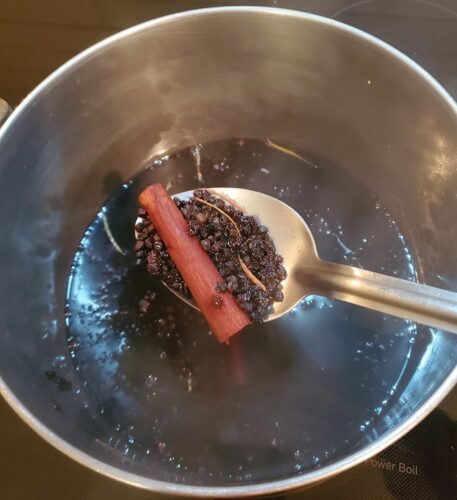
If you’re looking for a simple elderberry syrup recipe for boosting your immune system, you’ve come to the right place. It’s easy to make elderberry syrup at home for immunity support, to prepare for cold and flu season, or to give you a health boost any time of year.
There is so much more to learn about elderberries! We have been making elderberry syrup for years and just started growing elderberry bushes. In this article, we provide a wealth of information to help you understand how elderberries work. We also address warmings about using the elderberry plant and offer you some reliable references for your own further research if desired.
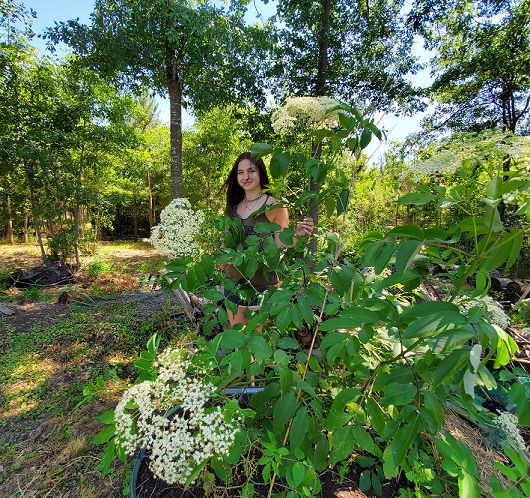
We still purchase dried elderberries to make syrup because our elderberry trees are not yet mature. You can easily find dried elderberries for sale on Amazon and other purveyors such as Mountain Rose Herbs. Here’s a look at the most recent organic elderberry product we bought:
This post may use affiliate links. If you make a purchase, we might make a small commission. ALL commissions, every single cent, is invested back into Home Grown Fun’s educational products and programs.
What is Elderberry Syrup made of?
Elderberry syrup is a reduced liquid made from the berries of the elderberry plant, water, spices, flavorings, and sweeteners such as maple syrup and honey.
What are the Potential Benefits of Elderberry Syrup?
Elderberry syrup is a rich source of vitamin C, fiber, and minerals, and has been shown to have anti-inflammatory, anti-viral, and anti-bacterial properties. Regular consumption of elderberry syrup is believed to boost the immune system, improve heart health, and provide relief from cold and flu symptoms.
Elderberry syrup is also considered a natural remedy for cough, allergies, and other respiratory conditions.
Elderberries have a reputation for being a superfood and are also used worldwide for medicinal purposes. An article from the Ohio State University Wexler Medical Center claims they have 10 times the amount of antioxidant compounds of other berries.
Does Elderberry Syrup Shorten a Cold?
Elderberry syrup may shorten the duration of the common cold. Many studies have explored the benefits of taking elderberry syrup and extracts to reduce the length and severity of the common cold. A study published in the US Library of Medicine analyzed the duration of the common cold after treating travelers with elderberry. People were given elderberry up to 10 days before travel and 4–5 days after arriving at their overseas destinations. Elderberry reduced cold symptoms and shortened the duration of colds by 2 days.
Here are five good journal articles / studies that suggest elderberries can reduce the duration of the common cold:
- “Randomized study of the efficacy and safety of oral elderberry extract in the treatment of influenza A and B virus infections” by Zakay-Rones, et al. in The Journal of International Medical Research (2004)
- “Elderberry Supplementation Reduces Cold Duration and Symptoms in Air-Travellers: A Randomized, Double-Blind Placebo-Controlled Clinical Trial” by Tiralongo, et al. in Nutrients (2016)
- “Elderberry supplementation reduces cold and flu symptoms in an air-travelling population: A randomized, double-blind placebo-controlled clinical trial” by Hawkins, et al. in Complementary Therapies in Medicine (2019)
- “Effectiveness of elderberry extract in preventing colds and upper respiratory tract infections: a systematic review and meta-analysis of randomized, controlled clinical trials” by Hawkins, et al. in The Journal of Evidence-Based Complementary & Alternative Medicine (2020)
The studies above suggest that elderberry extract or supplementation may be effective in reducing the duration and symptoms of the common cold. However, it’s important to note that more research is needed to confirm these findings and to determine the appropriate dosages and forms of elderberry to use. As always, it’s best to consult with a healthcare professional before starting any new supplement regimen.
Can too much Elderberry Syrup be Dangerous?
There is research that addresses the negative effects linked to elderberry, and the liver specifically. Have you ever heard the saying, “Too much of a good thing?”. One journal article in the Journal of Clinical Gastroenterology provides information on the potential association between long-term use of elderberry supplements and autoimmune hepatitis.
People who are Pregnant or Breastfeeding: In addition, because there is limited information available on the safety of elderberry supplements or products for pregnant and breastfeeding women, it is generally recommended that pregnant and breastfeeding women avoid using elderberry supplements.
Infants: If you use honey to sweeten elderberry syrup, do not give to infants under 12 months of age. This is because honey can contain spores of the bacterium Clostridium botulinum, which can produce a toxin in a baby’s immature digestive system and cause infant botulism, a rare but serious type of food poisoning.
Herbal supplements will affect people differently. Be careful with homemade remedies and consult with your doctor if you experience any issues.
How do Elderberry Plants grow?
If you’re interested in growing your own elderberries, here is some basic information about the plants:
The most common elderberry varieties are the American elderberry (Sambucus canadensis) and the European elderberry (Sambucus nigra) They grow into large bushes and produce small fruit and pretty flowers. We grow Ranch, York and Black Lace elderberries, all American elderberry varieties.
- Size and shape: Elderberry trees can grow up to 10-12 feet tall and wide, with a rounded or spreading habit.
- Leaves: The leaves are pinnately compound, meaning that they are composed of several leaflets arranged in a feather-like pattern.
- Flowers: The flowers are creamy white, arranged in large, flat-topped clusters that can be up to 10 inches across. The flowers bloom in early to mid-summer and are attractive to pollinators such as bees and butterflies.
- Fruit: The fruit is a small, dark purple or black berry that ripens in late summer or early fall.
- Growing requirements: Elderberry trees are adaptable and can grow in a variety of soil types, but they prefer moist, well-drained soil in full sun to partial shade. They can tolerate some drought, but will produce better with consistent moisture. They are hardy in USDA zones 3-9.
- Maintenance: Elderberry trees can be relatively low maintenance, but benefit from pruning to remove dead or damaged wood and to encourage new growth. They can also be susceptible to some pests and diseases, so it’s important to monitor the tree’s health and address any issues promptly. Elderberries can be affected by elderberry borer, aphids, spider mites, fungal diseases and root rot.
- Cross pollination: Most elderberry cultivars are self-fertile, meaning that they can produce fruit with their own pollen. However, some cultivars may benefit from cross-pollination with another elderberry plant to increase fruit set and yield. Cross-pollination benefits Adams, Nova, York, and Johns. If you’re planting elderberries and want to ensure good cross-pollination, it’s best to plant two or more cultivars that bloom at the same time. This will increase the chances of bees and other pollinators transferring pollen between the plants.
Are all Parts of Elderberry Edible?
The fruit and the flower are edible. The flower is safe to eat raw or cooked. However, raw elderberries can be toxic and cause severe stomach upset. It’s important to cook elderberries first! Stems, leaves and roots are toxic and should not be consumed.
The stems, leaves, roots and unripe fruit of the elderberry plant contain a type of cyanide-producing glycoside called “sambunigrin,” which can cause nausea, vomiting, and diarrhea if ingested in large quantities. Therefore, it is important to cook the berries before eating them and avoid consuming other parts of the plant. The ripe berries and flowers of the elderberry plant are generally considered safe for consumption when cooked or processed correctly.
If Using Fresh Elderberries, Ensure they are Ripe
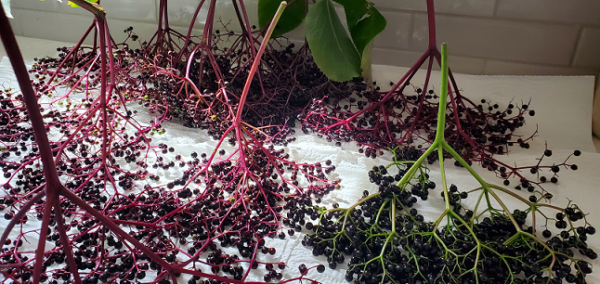
Elderberries should be ripe before consuming, as unripe elderberries are toxic and can cause gastrointestinal distress. Look for elderberries that are deep purple or black in color. If the elderberries are still green, red, or pale in color, they are not ripe yet. Elderberries typically ripen in late summer or early fall, depending on the climate and location. If using fresh berries, double the amount in the recipe below.
Money Saving Recipe for Elderberry Syrup
A jar of elderberry syrup makes a wonderful gift! I once saw a small bottle of elderberry syrup priced at $35 in a convenience store near Folley Beach, South Carolina! Making your own elderberry syrup can add up to substantial cost savings. A 1 pound bag of dried elderberries (454 grams) would give you approximately 5 cups of dried berries.
The recipe below uses 1 cup of berries and produces 6 1/2 cups of syrup (1.54 liters). Therefore you can make 32.5 cups of elderberry syrup with one bag of dried elderberries. And a bag of dried elderberries is approximately $20 USD. Add in some cost for sweetener (if you use any) and you are saving some serious cash.
How do you Sweeten Elderberry Syrup?
The rule for a sweet elderberry syrup is to use a 1:1 ratio of elderberries to honey and/or maple syrup. For example, if you use 1 cup dried elderberries, use 1 cup total of sweetener. Our favorite way to sweeten elderberry syrup is to use half real honey and half real maple syrup. Use less sweetener if you desire or no sweetener at all!
You can Easily Adjust the Ingredients in Elderberry Syrup!
You can vary the ingredients to your taste. For example, if I’m making a batch for my youngest daughter, I add fresh or frozen cranberries and cherries to give it an exciting fruit punch flavor! I leave out the ginger and use less sweetener, no honey and only maple syrup. She’s not a fan of the flavor of honey. Maybe she was adopted!
The great thing about this recipe is it is flexible and customizable. You really can’t go wrong. The key is to bring the water and elderberries to a boil, then quickly turn down to simmer for 30 minutes minimum. All the other ingredients are optional!
How Long should you Cook Elderberries to Ensure they are Safe to Consume?
As outlined by the National Center for Home Food Preservation, elderberries should be cooked for at least 15-20 minutes at a temperature of 80°C (176°F) to break down the sambunigrin and other potentially harmful compounds, making the berries safe to eat. After cooking, the berries can be used to make jams, jellies, syrups, and other delicious treats.
Recommended Serving Size for Elderberry Syrup and a Tip
Take 2 tablespoons 1-3 times a day. If you’re lazy like we are, fill small jars with elderberry syrup and write the name of each family member on them. Take a small swig once a day. No spoons or spills! Again, as addressed above, be careful to not overdo it and to consider the potential downside of taking elderberry regularly.
The recipe below yields a total of 6 1/2 cups (1540 mL) of elderberry “syrup”. Because homemade elderberry syrup does not contain fillers or thickeners, it will not be a thick syrup.
Serving size is 2 tablespoons (30 mL). There are approximately 43 servings in the recipe.
Consult a health practitioner if you are concerned about taking any “natural” remedy.
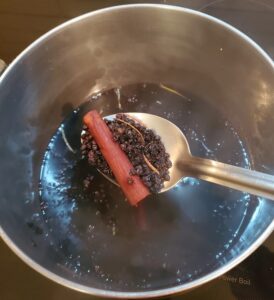
Ingredients for Making Elderberry Syrup
- 4 cups water (.95 L)
- 1 cup dried elderberries (.25 L) If using fresh elderberries, double the amount and make sure they are ripe.
- 2 tablespoons chopped ginger (29.6 mL) OPTIONAL
- 1 tablespoon lemon zest (15 grams) OPTIONAL
- 1 teaspoon whole cloves (5 grams) or 1/2 teaspoon ground cloves (2.5 grams) OPTIONAL
- 1 cinnamon stick (OPTIONAL)
- 1 teaspoon vanilla or star anise extract (5 grams) Star anise will infuse the syrup with a slight licorice flavor OPTIONAL
- 1/2 cup real maple syrup (118 mL) OPTIONAL
- 1/2 cup real local honey (118 mL) OPTIONAL
Easy Instructions for Making Homemade Elderberry Syrup:
- Cook the Elderberries: In a big pot combine dried berries, water and flavorings – get it going on high to almost a boil, partly cover, and turn down to a very low simmer for 30 minutes. After the 30-minute simmer, remove the pot from the burner and gently mash the ingredients. Place back on the heat source, simmer uncovered for another 15 minutes.
- Capture the Elderberry Juice and Flavorings: Turn off the heat. Press the mash through a strainer to capture the liquid into a bowl. (Feed the remnants to the compost or red wiggler worms.) Let the syrup cool for 15 minutes.
3. Add Sweetener(s): Mix in the maple syrup and honey thoroughly. You can opt to use only one type of sweetener or none at all. Experiment!
Pour into jars. Store in the refrigerator and use within 3 weeks. There are blog posts on the Internet that say you can keep elderberry syrup on the counter, unrefrigerated. That is not a good idea. Manufactured, store-bought elderberry syrup has ingredients and preservatives that give it a long shelf life. Homemade elderberry syrup will spoil and ferment if not refrigerated.
Take 2 tablespoons up to 3 times a day, or take as instructed by your practitioner.
Can you Freeze Elderberry Syrup?
Yes, indeed. The best method may be to pour into ice cube trays. Once frozen, remove the cubes and place in a freezer safe container or bag. Raw honey will not crystallize when frozen.
Can you reuse the spent elderberry pulp and make more syrup?
Yes, I do this all the time. The resulting liquid will be less concentrated. I add 1-2 cups of water and gently heat the mixture on low heat for 10 minutes to release more flavor. Then I feed the remaining pulp to my composting worms. I never throw it away.
Other Ways to use Elderberry Syrup
- Dip waffles or apple slices in elderberry syrup!
- We’ve also made “elderberry fizz” by adding 2 tablespoons to 1/2 cup of carbonated water over ice.
- Make a tincture using vodka or brandy for a longer shelf-life. It takes months to prepare this concoction.
6 Ways to Use Elderflowers
- Brew some delicate, floral flavored tea. Recipe below.
-
Elderflower cake: Elderflower can be added to a basic cake batter to give it a light, floral flavor. You can use elderflower syrup, fresh or dried elderflowers, or elderflower cordial to flavor the cake.
-
Elderflower muffins: Adding elderflower to muffin batter is an easy way to infuse the muffins with a light, sweet flavor. You can also add elderflower to the glaze or frosting for an extra burst of flavor.
-
Elderflower scones: Elderflower can be added to scone dough to give them a delicate floral flavor. Serve them with clotted cream and jam for a classic British treat.
-
Elderflower shortbread: Adding elderflower to shortbread dough gives it a delicate, floral flavor that pairs well with tea or coffee.
-
Elderflower macarons: Elderflower can be added to macaron batter to give the delicate, almond-based cookies a light, floral flavor. You can also add elderflower to the buttercream filling for an extra burst of flavor.
How to Make Elderflower Tea
Ingredients:
- 2-3 fresh elderflower heads or 1-2 tablespoons of dried elderflowers
- 2 cups of water
- Optional: honey or lemon to taste
Instructions:
- Rinse the elderflowers under cold running water to remove any dirt or debris.
- Bring 2 cups of water to a boil in a saucepan.
- Once the water is boiling, remove the saucepan from the heat and add the fresh elderflower heads or dried elderflowers.
- Cover the saucepan with a lid and let the elderflowers steep for 5-10 minutes.
- Strain the tea through a fine-mesh sieve into a teapot or serving pitcher.
- Add honey or lemon to taste, if desired.
- Serve the tea hot, or let it cool to room temperature and serve over ice.
Note: Elderflowers have a delicate flavor and aroma, so it’s important not to over-steep them or use too much in the tea. You can adjust the amount of elderflowers and water in this recipe to suit your taste preferences. You can also combine elderflowers with other herbs, such as chamomile or mint, to create a more complex and flavorful tea.
Elderberry Pie
Elderberry pie is a traditional dessert in some cultures, especially in Europe. The ripe elderberries are typically cooked with sugar and sometimes combined with other ingredients like lemon juice or cornstarch to create a sweet and tangy filling. The filling is then poured into a pie crust and baked until the crust is golden brown and the filling is bubbling. Elderberry pie can be served warm or cold and is often topped with whipped cream or vanilla ice cream.
Ingredients:
- 1 double pie crust
- 5 cups of elderberries, stems removed and washed
- 1 cup of granulated sugar
- ¼ cup of cornstarch
- 1 tablespoon of lemon juice
- 1 tablespoon of unsalted butter, cut into small pieces
- 1 egg yolk
- 1 tablespoon of heavy cream
Directions:
- Preheat your oven to 375°F (190°C).
- Line a 9-inch (23 cm) pie dish with a pie crust.
- In a large bowl, mix the elderberries, sugar, cornstarch, and lemon juice until well combined.
- Pour the elderberry mixture into the pie crust.
- Dot the top of the elderberry mixture with small pieces of butter.
- Roll out the second pie crust and use it to cover the top of the pie. Use a sharp knife to cut slits into the top of the pie crust to allow steam to escape.
- In a small bowl, whisk together the egg yolk and heavy cream. Brush the egg wash over the top of the pie crust.
- Bake the pie for 45-50 minutes, or until the crust is golden brown and the filling is bubbly.
- Remove the pie from the oven and allow it to cool to room temperature before serving.
Nutritional Value the Elderberry Syrup Recipe in total protein, carbohydrates, and fiber:
Amounts below are based on 2 tablespoons per serving, are approximate and could vary.
- Protein: .00698 grams (from ginger and cloves).
- Carbohydrates: 17 grams (from elderberries, maple syrup, and honey). Remove the sweetener and reduce the carb count dramatically, 1.2 grams if unsweetened.
- Fiber: .63 grams (from elderberries and lemon zest).
The above may vary on many factors such as serving size, cooking method, and additional ingredients that may be added.
Learn more about the ingredients in the elderberry syrups recipe:
- Elderberries: Elderberries are rich in antioxidants such as flavonoids and anthocyanins, which can help protect cells from oxidative stress. They are also a good source of vitamin C, which is important for immune function and skin health.
- Ginger: Ginger contains several bioactive compounds such as gingerol, which have anti-inflammatory and antioxidant properties. It is also a source of potassium, magnesium, and vitamin B6.
- Lemon zest: Lemon zest contains vitamin C, which is important for immune function and skin health. It also contains small amounts of calcium and potassium.
- Cloves: Cloves contain several vitamins and minerals, including vitamin C, vitamin K, and manganese.
- Cinnamon: Cinnamon contains small amounts of calcium, iron, and manganese.
- Maple syrup and honey: While these sweeteners do not contain significant amounts of vitamins or minerals, they do contain small amounts of antioxidants and may offer some potential health benefits when consumed in moderation.
Note that the amounts of these vitamins and minerals may vary based on factors such as the quality and processing of the ingredients, as well as the method of preparation.
Check out other DIYs at Home Grown Fun:
Seed Starting Mix and Potting Soil
Stock Tank Pool – Quick Startup – No Drilling Holes
COMMON QUESTIONS ABOUT ELDERBERRY SYRUP AND ITS EFFECTIVENESS, and potential benefits for preventing or treating the common cold.
- Elderberry syrup and the common cold
- Does elderberry syrup prevent colds?
- Elderberry syrup benefits for cold and flu
- Elderberry syrup for immune support
- Elderberry syrup antiviral properties
- Evidence for elderberry syrup and cold prevention
- Elderberry syrup and respiratory infections
- Elderberry syrup and influenza
- Clinical studies on elderberry syrup for colds
- Elderberry syrup effectiveness for colds
REFERENCES:
Zakay-Rones, Zichria, et al. “Randomized study of the efficacy and safety of oral elderberry extract in the treatment of influenza A and B virus infections.” The Journal of International Medical Research, vol. 32, no. 2, 2004, pp. 132-40.
Tiralongo, Evelin, et al. “Elderberry Supplementation Reduces Cold Duration and Symptoms in Air-Travellers: A Randomized, Double-Blind Placebo-Controlled Clinical Trial.” Nutrients, vol. 8, no. 4, 2016, p. 182.
Hawkins, Joy, et al. “Elderberry supplementation reduces cold and flu symptoms in an air-travelling population: A randomized, double-blind placebo-controlled clinical trial.” Complementary Therapies in Medicine, vol. 42, 2019, pp. 361-365.
Hawkins, Joy, et al. “Effectiveness of elderberry extract in preventing colds and upper respiratory tract infections: a systematic review and meta-analysis of randomized, controlled clinical trials.” The Journal of Evidence-Based Complementary & Alternative Medicine, vol. 25, 2020, p. 1-15.
Ohio State University Wexner Medical Center. “Elderberry Packs Powerful Antioxidant Punch.” ScienceDaily, ScienceDaily, 4 Apr. 2019.
Izzo, Alessandro, et al. “A Plausible Association Between the Use of Elderberry and Autoimmune Hepatitis?” Journal of Clinical Gastroenterology, vol. 53, no. 10, Nov./Dec. 2019, pp. e404-e406.
